Every year Berlin’s landscape changes into a carpet of grand exhibitions, while the city holds its breath for the by now renowned Berlin Gallery Weekend. In between first of May dances and ceremonies held in remembrance of 70 years of liberation from fascism, 47 galleries and several more art spaces join forces to accommodate artists from all over the world.
Time rewinds and shuffles like a deck of cards, while the world is scanned and examined within an overwhelming variety of artworks and art forms – including a virtual rainforest in the midst of Berlin. Urban planning is juxtaposed with inner thought processes of societies: The evolution of human kind, their formation in crowds, and the perception of our environments due to languages that occasionally find themselves in linguistic culs-de-sac. Clearly Arthur Danto’s notion of the End of Art resulted in the effervescence of resourcefulness that is let loose once a year in Berlin – the unanswered question of the boundaries between design object, furniture, and art peacefully gleaming in the distance.
“To dew her orbs upon the green”[1]
Dries Van Noten Pastizal by Alexandra Kehayoglou at Kaufhaus Hertzog, Brüderstraße 26, 10178 Berlin
It is rare to see a fashion show staged in such a theatrical manner that it blurs the lines between performance art and runway show, as was seen in Dries Van Noten’s Spring/Summer 2015 show in Paris, in which the designer orchestrated the presentation of his collection around a 48-meters carpet by Buenos-Aires-based artist Alexandra Kehayoglou. Drawing from John Everett Millais’ 19th century painting “Ophelia”, Van Noten created a world of dreams and illusions, directly translating William Shakespeare’s sentiment of “A Midsummer Night’s Dream” onto the runway. On the third floor of the abandoned department store Hertzog in Berlin, the carpet is set on the right-hand side of the room, with artificial overhead lights illuminating its various details, while birds soothingly chirp in the background. The display brings to mind a forest thicket, as if nature was reclaiming its territory with mossy plants covering the floor. In combining carpeting with fine arts, Kehayoglou goes back to her Argentinian roots: Her ancestors brought over the art of traditional rug making from Greece, creating one of the biggest carpeting industries in South America. In her family’s El Espartano factory, the artist picked up the craft, which she later merged with her degree in painting and photography. For Dries Van Noten’s fashion show, she hand-tufted pure Patagonian wool to four separate canvases, which are reassembled each time they are on display. Her passion for carpeting enhances the two-dimensional art of painting in giving it a spatial aspect that unifies functionality and design – stretching the boundaries of art itself. With her unique approach to uniting nature and fabrics, interior and exterior melt into a biomorphic, abstract composition.
Riot Art
Cyprien Gaillard at Sprüth Magers, Oranienburger Str. 18, 10178 Berlin, May 2 – July 18
Cyprien Gaillard, who for his part is not averse to partying, delivers the artistic highlight of this year’s Gallery Weekend with his 3D film “Nightlife” that restores the raison d’être of 3D movies. As part of his exhibition “Where Nature Runs Riot,” the film starts in Cleveland, where Rodin’s impaired bronze cast of “The Thinker” is shimmering in yellow-green shades in the artificial lighting. The scene slowly makes way for a familiar motif in Gaillard’s works: the “Hollywood Juniper,” an immigrant tree from Asia that dances vigorously in Gaillard’s wind machine, its whimsical, twisted branches swaying like whips against the surrounding wire-fences. This strangely tranquil state of violence is complemented by a sample taken from Alton Ellis’ song “Blackman’s Word,” which was later changed to “Black man’s pride,” whose chorus-lines are played in a loop, absorbing the viewer into Gaillard’s mesmerizing visual world. The camera shifts again, now depicting a drone flight above the Berlin Olympic Stadium in midst of a firework. The breathtaking footage takes the viewer in and out of the spectacle, looking down at the stadium designed by Werner March and Albert Speer, the latter being Hitler’s go-to architect in the Third Reich. In winning four gold medals at the Olympic Games held in Germany back in 1936, Jesse Owens taunted Nazi Germany and its racist ideology – a citation that is elaborated on in Gaillard’s depiction of a German oak tree and in his double-exposure Polaroid series, which is (appropriately enough) entitled “Sober City”. Gaillard lets the viewer pick up the different pieces to unlocking the underlying critique on racism. His subtle incorporation of riot quotations taken from different contexts is what makes his work so intriguing, the music’s delay creating a maelstrom that generates a state of trance in this beautiful rebellion of nature.
Obstacles
Navid Nuur at Galerie Max Hetzler, Goethestr. 2/3, 10623, April 30 – May 30 2015
Galeria Plan B, Potsdamer Str.77-87, 10785 Berlin, May 1 – June 27 2015
Iranian-born artist Navid Nuur mines stony memories at Galeria Plan B and Galerie Max Hetzler, where rocky obstacles build the core of his exhibition. Yet, the first obstacle the visitor has to overcome is the work “Untitled (Let us meet inside you),” which consists of crates of bottled water that are stacked at the gallery’s entryway. In the middle a tap sticks out, one that supposedly leads directly to the artist’s studio and from which the gallery employees take water to fill the 0.33 liter glass bottles. Sold in crates of 100, on the inside the bottles read, “Let us meet inside you” – a suggestion that might as well have come from Lewis Carroll himself and is meant quite literally, as the artwork with all its creative attribution would be absorbed, intermingling with the consumer once drunken. For his two-minute video installation, “Not yet titled (video what I call),” Nuur cut TED speeches to manifest the platitude that has crept into the English language, its representation strangely oscillating between artwork and YouTube video. His split exhibition “Mining Memory” incorporates diverse forms of stones: from batik-like graphite on Gampi works, to engraved copper plates, and petrified dinosaur feces – all part of a fictional interview with a rock. The exhibition’s motif of stones is continued on at Galeria Plan B, where “The passing” resumes the series of hand-cut glass that is attached to the gallery walls with climbing grips. His stone assemblage integrates smoothly into the setting of the dim-lit gallery, where a metal reflecting sheet is set in a dark backroom, while the visitor is instructed to take a photo with flash in order for its green and black coloring to reveal its saturated luminosity: “The Main Remain Nr. 2,” the secret winner of Nuur’s exhibition.
Follow me to Ngorongoro
Group exhibition Ngorongoro, Berlin-Weißensee, Lehderstraße 34, 13086 Berlin
A vivacious fountain of creativity opens up on the edge of Berlin. With over 100 participating artists, the Artist Weekend showcased the group exhibition “Ngorongoro,” creating an oasis far away from the rush of the Gallery Weekend – including a warm-water pool, barbecuing, and about 400 artworks. Set on the premises of a former GDR semiconductor factory in Berlin-Weißensee, the 5000 square-meters site holds several ateliers and studios. Over the weekend, the workspaces are transformed into one big exhibition space that suggests the forbidden atmosphere of the early days after the fall of the Berlin Wall with just a hint of trespassing. When the artisans around Jonas Burgert initiated the project, they told their befriended artists to invite others to join, leaving them with an overwhelming abundance of artworks that are scattered all over the grounds. A narrow metal staircase leads upstairs, where a rumbling wall of speakers awaits the visitor. The walls are replete with paintings, the high ceilings covered in wallpaper that is slowly peeling off of them. Along with a drum installation by Anri Sala and a screening by Julian Rosefeldt, works by international artists such as Bruce Nauman, Polly Morgan, and Mat Collishaw are presented in this unique setting far away from the museum establishment. With its winding passageways and corners, it is easy to get lost in the maze of artworks. Yet, it is the overload of different art forms from installations, over sculptures, paintings, photography, and multi-media art that make “Ngorongoro” this unique habitat of creativity.
The House that Klara built
Klara Lidén, Galerie Neu, Linienstr. 119 ABC ,10119 Berlin, May 1 – June 6 2015
When Klara Lidén walked around Berlin’s beautiful urban landscape, she couldn’t help but notice the peculiar stone slabs that pave the city’s sidewalks. Some of them stem from the second half of the 20th century and exhibit the particular format used in the GDR. In her exhibition at Galerie Neu, the Swedish-born architect addresses Berlin’s cityscape that is currently expanding in all direction. For “Do Not Bench,” she measured the gallery’s dimensions using a miniature model to translate the city’s metamorphosis into the microcosm of the art space. In combining stone slabs and wooden boards from construction-site scaffolds, she creates several benches that display Berlin’s urban environment. Instantly Lidén poses the question whether this is furniture, or artwork – a paradox that cannot be dissolved. Floating above the room are big white canisters that serve as lamps with the filling capacity of one cubic-meter – exactly the dimension with which the artist measured the gallery. Traces of that measurement are visible in the pink spray paint marks that are left here and there on the artworks. Lidén’s work engages the viewer with fundamental questions about their environments that are constantly changing, while these transformations, again, create new entities in this world. In “Do Not Bench” she resumes her work of disclosing traces of urban planning that are passed by unnoticed in the somnambulism of everyday life.
The Amazons’ melancholy
Martin Eder – Galerie Eigen + Art, Auguststraße 26, 10117 Berlin, May 1- May 23 2015
Martin Eder is one of those artists who establish a particular visual language that immediately draws the viewer into a world that questions the very reality we live in. In between tacky images of cats, bunnies, or poodles, Eder is concerned with eroticism and mutilated nudity that tells the story of hyper realistic surrealism. Just as photography, Eder’s depictions become more and more life-like, ostensibly increasing the number of pixels that create high-definition paintings. In his exhibition “Those Bloody Colours,” the artist presents paintings of women in armor that are imbued with color and charged with physical energy. In an almost photographic manner, Eder paints these powerful, yet fragile creatures that convey an inherent sadness set in a cosmos of fairy tales. The paintings are engaged with the reciprocal relationships between viewer and artwork, strength and weakness – the hyperrealism seemingly revealing all of their secrets. With their eyes turned away from the viewer, the women remain a sense of mystery, which discharges in a spiritual aura perceptible in the gallery. Only the woman in “Dark Soil” gazes directly back at the visitor. Her hooded figure appears as a threatening protagonist in his exhibition, holding a sword in front of her naked body, which is only covered by a cloak. Eder’s series of paintings opens up a new dimension of reality, the women luring the viewer into the story they inhabit. Like Amazons these ominous creatures wait in eerie calm – every man for himself.
Reverse Gentrification
Renzo Martens – KOW, Brunnenstraße 9 10119 Berlin, May 1 – July 26 2015 /
KW Institut, Auguststraße 69, 10117 Berlin, May 1 – June 7 2015
The Dutch artist Renzo Martens is working on gentrifying the rainforest. An endeavor that in the past has been compared to Werner Herzog’s movie “Fitzcarraldo,” in which Klaus Kinski plays an adventurer trying to build an opera house in the midst of the Amazon rainforest. Admittedly, Martens project of interfering with the African art scene gives rise to controversy. The two-edged sword of his brainchild “Institute for Human Activities” is concerned with giving the Congolese people a chance to participate in the international art market. While the money generated with African goods, be it artworks, video footage taken there, or cocoa beans, often doesn’t reach the people in the Congo, Martens tries to actively involve them in the art scene, whilst reimbursing them for their work. In his exhibition “A Lucky Day” at KOW, Martens presents the artwork by the Congolese Plantation Workers Art League, which consists of six sculptures, two of which are self-portraits. The clay sculptures made in the Congo were scanned in order to create a mold, from which they could then be cast in solid Belgian chocolate. This rather symbolic materiality serves as underlying criticism of the exploitation of the Global South. At KW Institute, just a short walk away, Martens presents the exhibition “A Matter of Critique,” where his video footage engages in the depiction of his actual work. As one of the plantation workers notes, Martens might want to revise the description of his project to “reverse-gentrification” program – a name much less provocative.
Press Play
Franz Gertsch – Galerie Michael Haas, Niebuhrstraße 5, 10629 Berlin /
Kunst Lager Haas, Lise-Meitner-Straße 7-9, 10589 Berlin
Franz Gertsch is known for taking his time to finish a piece, to really grasp the imagery, and discharge his impressions onto the canvas. His large-scale pictorial woodcuts are hung next to works by French avant-garde painter Francis Picabia at Galerie Michael Haas, one of the gallery’s venues in Niebuhrstraße. With a new location in Berlin-Charlottenburg, the married couple Haas has created their own infrastructure of art industry in the 8000 square-meters large building that includes the gallery, an event space, a photo studio, and a frame warehouse. Set in the newly constructed art space, Gertsch’s retrospective of hyper realistic paintings complements the modern interior of the location. Over and over again, his works bring the visitors to the limits of their perception, not knowing whether his works are paintings or really photographs of a razor-sharp reality. When looking at Getsch’s works, his influences from the 1970s are very much apparent. Alongside two early paintings of hippy culture that fathom the peaceful atmosphere of that time, natural landscapes and detailed portraits are presented. Gertsch has a rare talent of generating sceneries that convey the aesthetics of a film still rather than a painting. In “At Luciano’s House,” Gertsch does exactly that: three young women are depicted in a cluttered room, in the midst of which a butterfly is captured mid-flight. The fruitful moment of their departure has the viewer waiting for the scenery to be played back, so the women and the butterfly can embark on their journey.
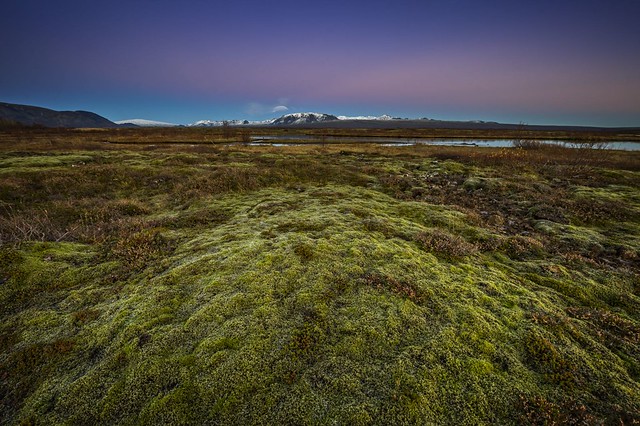
(Photo: Flickr, “Moss“, by Ævar Guðmundsson, (CC BY 2.0))
Published in Zoo Magazine #47, June 2015, p. 64-67.
[1] William Shakespeare’s A Midsummer Night’s Dream, Act II, Scene I.
 Julia Kausch