Descending into Denpasar airport, Garuda’s statue is the first thing that catches your eye. Its positioning and sheer size evoke the imagery of Liberty Island in New York. Beacon of freedom? Its eastern counterpart promises immortality instead; in today’s world the backdrop of Bali’s new order looks a lot like a crossover between Alice in Wonderland and Mad Max, a trend set at the 2019 Gypsy Land festival. High as kites, they fly off on their surfboards, the sunset reflecting off their glittery faces. Watching over them is the latest Volcom ad, Bali’s very own equivalent to the Gucci billboard as seen from Chateau Marmont in Los Angeles.
The Island of Gods is in a state of spiritual imbalance. For some Balinese, this lopsidedness manifests very literally: They attribute it to the construction of the Garuda Wisnu Kencana statue, a 122-meter-high monument of the mythical eagle Garuda that was inaugurated on September 22, 2018, 30 years after it was first conceptualized. With a wingspan of 64 meters, the eagle statue rests on a large pedestal in the center of Bali’s southern Bukit peninsula.
As the national symbol of Indonesia, Garuda can often be seen carrying in its claws the Indonesian motto: Bhinneka Tunggal ka – Unity in Diversity. Minus Judaism, of course. In reference to Bali, however, it also refers to the Hindu myth in which the powerful eagle Garuda steals the elixir of immortality to free his enslaved mother. Nuances about karma, hubris, and a godly presence in nature encompass Garuda, a myth that ties into the essence of the old Bali. The ambiguities that surround the eagle become emblematic when looking at Bali’s and Indonesia’s current socio-political state.
Up The River
“The art of life lies in taking pleasures as they pass, and the keenest pleasures are not intellectual, nor are they always moral.”
Aristruppus (Greek philosopher, student of Socrates, prince of hedonism)
The bartender lines up shot glasses on the counter and vanishes behind the bar for a few seconds. When he reappears, he is holding three silver-yellow bags in his hand. “Extrajoss,” says the label, listing ginseng, taurine, caffeine, and royal jelly as main ingredients. The little powdery powerhouse not only promises to be halal and sugar free, it contains most of the vitamin Bs. A healthy fun boost for everyone who does not have kosher dietary needs.
Yogi, the bartender, skillfully rips open three sachets of Extrajoss in one go, pours them into the shot glasses and fills them to them brim with vodka. Each one is stirred with a toothpick to mix the now yellow-foaming liquor. We cheers and drink up. It tastes exactly how it looks: sticky, sweet, and still fizzing on the tongue. The perfect kick for a night out – for every night: Get jossed, and don’t you dare starting with a homeopathic dosage. This is ad nauseam.
The party is right here, or just down the road – in the Westernized paradise, it can be wherever you want it to be really. The local culture has long made room for the steadily increasing load of tourists and their Joss-induced parties. Of course, the surface visibility of these parties only makes up a fraction of what is really going on behind closed doors, often those of bathroom stalls. The sound of lines being sniffed in the lady’s room of Canggu’s local pizzerias or sports bars is the audible hint of depravity in an otherwise picture-perfect holiday destination. Tumbling out of the bathroom stall a few minutes later, frantically wiping their noses, are usually coked-up business owners from Australia or Great Britain.
Only a few months ago, two Australian expats were caught with 1.12 grams of cocaine. Arrested in the back office of Canggu’s local nightclub Lost City during a raid that followed a tip-off, police found scales and baggies that led to additional charges of drug trafficking. As Lion Air’s standard announcement reminds us before touchdown in Lombok, the penalty for holding drugs in Indonesia is d-e-a-t-h. The woman’s voice could hardly sound any more chipper while outlining this fact, but luckily, the two Aussies only face a prison sentence up to twelve years. Phew. This is the place where East and West collide; if only they had listened to Aristruppus more carefully: “The vice lies not in entering the bordello but in not coming out.”
Island of Gods
“A person’s soul is deemed to be made of a drop of water (titisan) from above the mountains, where ancestral deities dwell.”
(Jean Couteau, Myth, Magic and Mystery in Bali, p. 71, 2017)
Why do they call it the Island of Gods anyway? After setting foot on its beautiful shores, it is not hard to imagine how this name came into existence. Surely the gods themselves would want to live here. But where are they?
Hugging the larger island of Kalimantan on a shoestring tugged between Sumatra, Java, and Nusa Tenggara, Bali is situated only eight degrees South of the equator. Lush flora set in volcanic landscapes, Bali’s uniqueness is olfactorily enhanced by the smell of incense being burned for the daily offerings and purification of the Balinese houses. This distinct scent will forever create a “memoire involuntaire” (involuntary memory) – a sensory throwback to a memory and certain time in one’s life that is triggered by the sense of smell; whenever incense are burning somewhere, it takes me right back to Bali.
The island is thought to have once connected to its neighboring island Java. Legend has it that the larger island (Java) formed the head of a roaring dragon, the tale of which would later become Bali. To end the dragon Anantaboga, Ida Bagus Manik Angkeran severed its tale with a sword. Bali was born. Bagus!
The Balinese only make up around 1.6 percent of the Indonesian population. In many ways, the island is very different from the rest of Indonesia, which is home to 271,000,000 people, a whopping 87 percent of who are Muslim. In contrast to the rest of the country, roughly 84 percent of Bali’s inhabitants practice Balinese Hinduism. “The intricacies of the Balinese Hindu beliefs are overlooked when in fact understanding them helps us to appreciate what one sees around the island everyday,” Jean Couteau writes in his book Myth, Magic and Mystery in Bali, published back in 2017. In his texts, the Bali-based French author focuses on cultural practices as well as social and political aspects surrounding Indonesia.
Often controversial and sarcastic in his writing, he has faced many obstacles in his career as journalistic writer for different Indonesian publications: “I write about social issues, about the working conditions, issues surrounding women, sexuality and freedom of expression. To me, self-censorship is very upsetting. In Indonesia we are free, but I can feel self-censorship increasing,” he explains.
We sit on the wooden terrace of his house in Denpasar. Facing West, the view opens into a lush valley flanked left and right by palm trees. A small stream is running through the scenery, its tranquility further enhanced by the sounds of tropical birds hiding in the trees. A Balinese woman appears from the kitchen, carrying a tray with two cups of coffee and plates of sliced mango. She places them on the small table in front of us and bows her head before she vanishes discretely.
Having lived in Bali for 30 odd years, Jean Couteau is an expert on culture, rituals, and myths surrounding the Island of Gods. Over the last decades, however, it has undergone drastic changes, as Couteau points out: “Many tourists come here and purchase a high standard of living at a cheap price. At the same time, they find themselves in a Hindu or rather a mixed-Indonesian environment. Perhaps half of the population in Southern Bali comes from Java or other parts of Indonesia. It is Bali, but it is somewhere else at the same time.”
Mythologically, Java and Bali are irreversibly linked. When the gods recognized the beauty and spirituality of Bali – the island they saw floating freely in the ocean – they decided to take a piece of Mount Meru in the Himalaya to stabilize the island. In Hindu belief, Mount Meru is thought to be the spiritual and (meta-)physical center of the universe. However, when putting the volcano in place, the gods mistakenly placed it in East Java, thus creating Mount Semeru. Noticing their mishap, the gods subsequently separated a chunk of Semeru and placed it in Bali, forming a new home for themselves on Mount Agung on the Island of Gods.

Order!
“Identity, a term will mean the same thing in an occurrence; Contradiction, a sentence and its negative cannot both be true; and ‘The excluded middle,’ either something is true or its opposite is true. In many circumstances, these three laws simply do not apply to Balinese logic and reasoning.”
(Fred Eiseman on Aristotle’s laws of thought, Bali: Sekala & Niskala. Essays on Religion, Rituals, and Art, p. 133, 2009)
“Clusterfuck,” is my first thought driving through Kuta’s center, the billboard hell where dreams of paradise come to die. Bali’s streets are pure havoc. Really, there is no apparent order to them. Only one thing is true on Bali’s streets: you’ll have to wiggle your way through. Scooters swerving past left and right, going into the incoming traffic, often with three or more people on them. Suffice to say, most do not wear a helmet. Westerners with surfboards, who are not used to driving scooters, let alone under such nerve-racking conditions, may be stuck in traffic for hours. If they do take the leap without any major injuries, chances are they have been to Bali before – previous injuries healed. Both traffic and infrastructure have expanded rapidly, however, the Balinese still hold a rather lax attitude towards the rules of traffic. The few rules that do exist seem to apply first and foremost to foreigners; there is a fine for everything.
When I first came to Bali in 2017, I was looking to book a trip to the small neighboring island Nusa Lembongan from the way too busy and obnoxiously pseudo-spiritual Ubud. “Eat, pray, love” really left a lasting impression on the – what I would imagine – once tranquil town in in the Gianyar province. Its authenticity has long been buried beneath ostensibly Balinese-Hindu Buddha statues that really have no place in Bali. “Symbols of culture are being fabricated to suit the expectations of tourists, which are mostly those of Western tourists,” Couteau weighs in. “Of course, you have aspects of Balinese tradition that entail notions of Buddhism. But why do you see Buddha everywhere when you go to a hotel nowadays? It is because Westerners expect to see Buddha when they are in Southeast Asia. So you have parts of Balinese traditions that are becoming Buddhified to suit tourist’s expectations,” he explains. But back to Ubud: The girl in the speedboat office on my first trip to Bali made the sale, handed me my ticket and added smiling: “The island is great, there is no police, so no need to wear a helmet.” She didn’t lie. Nusa Lembongan is one of my favorite places and seems to run smoothly without police. Of course, the rules of traffic follow those of Bali, minus the overcrowded roads. Needless to say, I was shocked to see two officers on a scooter when I arrived in Lembongan this time. Sigh of relief: neither of them was wearing a helmet.
“When I first came to Bali in the ‘70s, only about 20 percent of people had gotten a primary school education. Therefore, they were mainly shaped by their villages, … [in] puppet-show theaters and Balinese operas. There, they were taught how to behave and how to practice their religion. The notion of tolerance and the concept of God – [one] that is very broadminded – are changing. The Balinese are not as tolerant as they were,” Couteau explains. The author first arrived in Surabaya, Sumatra in the early ‘70s before he fully relocated to Bali a few years later. He lived amongst the locals, visited the smaller villages, and learned Bahasa (Indonesian) to delve more deeply into the welcoming village culture. “[B]ack then, there were no cars, almost no motorbikes, so Bali was still very much the genuine Bali. It was not urbanized to the extent that it is now. It was mostly agricultural and at that time the ideal place to be for someone wanting to be somewhere else.” Over the years, Couteau became part of the Balinese intellectual scene, which led him to become a writer and columnist following his PhD in arts and iconography.
With the New Order under president Haji Mohamed Suharto in the second half of the 20th century, Western influences began to increase rapidly. Oil trade, foreign investments, and funding made way for a new Indonesia that followed modernity and urbanization. With it, the country faced changes that brought with them economic growth and improvements in the education system and in turn affected both the Indonesian and Balinese society gravely. What meets the eye is merely touching the surface as tensions, inequality, and differences are becoming more pronounced. “[Y]ou have urbanization, but the main factors are education, modernity, and [the] arrival of new minorities from outside Bali. On the one hand, you see the social structure of Balinese society changing. Traditionally there was the ‘caste’ system. Now, you have big investors on the top – from Jakarta or China. … At the bottom, on the other hand, you have the immigrants.”
While order, education, and modernization are great improvements on the (socio-)economic scale, Western influences have left Bali oscillating between ancestral traditions and modernity, the old and the new, East and West. The Balinese find themselves in an identity crisis that fosters a focus on the individual over the collective. With it, life itself has moved from a unity of things within the universe, towards an Aristotelian, structured worldview. “We are advancing to a modernity in which everything is structured. Thought is being structured. Religion is being structured very much like roads and hospitals. … Everything is being given boundaries,” Couteau points out.
What are long-term results of the new order? As Couteau sees it, shit is going to hit the fan if things are progressing on their current course. To a large extent, this can be attributed to different religions and movements turning to religious and political texts for clarity to sort the mess that is (post-)modernism. Bigotry, religious fundamentalism as well as sexism, to name only a few… As the Guardian reported this September, a new law has been drafted that could outlaw extramarital sex, cohabitating for unmarried couples, and insulting the current president Joko Widodo. Sharia law is already in place in the Aceh province of Indonesia. And I can’t deny that while I am listening to the wise Frenchman, Michel Houellebecq’s face comes to mind; or is this triggered by his book “Submission,” published back in 2015, that outlines a Muslim party winning the 2022 presidential election, with patriarchy and fundamentalist Islamist laws gaining traction? Interestingly, Couteau’s wife is Muslim herself; could religious varieties and their respective influences not be a part of this discussion? Couteau explains: “The traditional tolerance is disappearing. A new tolerance is being engineered. This new tolerance is based on the rule of flow. You accept difference and you protect difference. Whereas in traditional tolerance … everything is the same; you don’t emphasize it.”
The Indonesian girl reappears on the spacious terrace. This time, she is carrying offerings and incense. Immediately, the scent works its calming magic. I think back to my recent arrival on Lembongan and feel a great sense of relief: The structuring of Indonesia does not seem to have crept into every last nook and cranny – in this case on top of police officers’ heads.
Air Suci
“The sanctity of the ocean water comes from the Parnuteran Mandara Giri myth, sometimes called ‘The Churning of the Sea Milk. … In the myth, Tirtha Amertha, the holy water of eternal life, was prepared by the combined energies of the gods and demons by using the largest mountain as a whisk and mixing all sorts of earthly effluvia into the ocean.” (Fred Eiseman on Aristotle’s laws of thought, Bali: Sekala & Niskala. Essays on Religion, Rituals, and Art, p. 62, 2009)
Certain travel anecdotes simply leave you feeling uneasy. Here it goes: Once upon a time, more precisely in early August of this year, an influencer couple from the Czech Republic went to Temple in Ubud, a lush tropical garden with streams of holy water running through it like veins. This spiritual backdrop creates the setting for a video showing the guy taking some holy water in his hand, lifting his girlfriend’s skirt, and slapping it on her bare ass. Holy fuck! Public outrage forced an apology, followed by a half-assed explanation about having been unaware of the sacredness of this place. Side note: In Balinese, the word ‘beji’ refers to purification by use of holy water. Of course, there are many other examples ranging from tourists having sex at temples sites or simply using them for Joss-induced party nights. The amount of incense and holy water necessary to purify Balinese temples is beyond me.
Tourism at its best creates a bilateral exchange of knowledge and experiences. Ernest Hemingway knew this, so did Goethe. Such accounts usually show that old-school content creators delved into the local cultures whenever they set foot on new shores. Have magnificent stories of travel and thrill made way for Instagram stories, clicks, and likes? Are we just craving sensationalism? With social media, have we created the sideshow of the 21st century?
Long gone seem the days of great minds such as Mark Twain, Jack London, and Agatha Christie, those authors who engaged in adventurous activities such as “surf-bathing” (Mark Twain, Roughing It, 1872), enlightened humanity about the wonders of the World. While Mark Twain’s was a proper 19th century kook, London seemed to have been relentless in his attempts to master the art of surfing. In his account of his travels through Hawaii (Surfing: A Royal Sport, from The Cruise of the Snark, 1911), the marvel and mysteries about his encounters take the reader straight to the ocean: “And suddenly, out there where a big smoker lifts skyward, rising like a sea-god from out of the welter of spume and churning white, on the giddy, toppling, overhanging and downfalling, precarious crest appears the dark head of a man.”
And Bali? Colonization and new influences from the West made Bali pop up on any surfer’s radar. Luckily, William Finnegan came to the rescue. At least when it comes to following into London’s footsteps. Only a few years ago, the author outed himself as a surfer, romantic thinker, and (post-)modern adventurer. More than simply evoking a lust for thrills, he sparks a feeling of melancholic longing that can only be described in German: Fernweh – to places that do not exist in reality, because they are too abstract, too personal, too emotionally charged. Would he have written about any of it otherwise? Surely not. His personal paradise will forever be an alternate universe living in his writing. A unique feeling of each place, challenges faced, and raw, uncensored personal accounts leave you wanting to pack your bags.
Bali, it seems, is the exception for Finnegan and travel buddy Bryan Di Salvatore: In Barbarian Days. A Surfing Life Finnegan recalls the two “mocking the notion then widespread among Australian surfers that Bali was still an unspoiled paradise of uncrowded waves and mellow Hindu natives” when, in fact, it “was overrun with other surfers and tourists.” Was Bali ever the empty surfers’ paradise it was once made out to be? It seems that even in the late 1970s, this was already make-believe.
Other than Hawaii, Bali did not have a surf culture that could be separated from tourism. The ocean, while holy and purifying, is considered to be a dangerous element in Balinese Hinduism, stepping into which could be considered hubris. Thus, surfing and tourism are deeply intertwined, carrying forth notions of a colonial Bali. “To a certain extent, Bali looks better than ever because people in certain villages have money now. Perhaps they don’t know the old stories anymore, but they know they have to be Balinese and Hindus here. … The temple ceremonies will thus be more beautiful than ever, but it’s fake.”
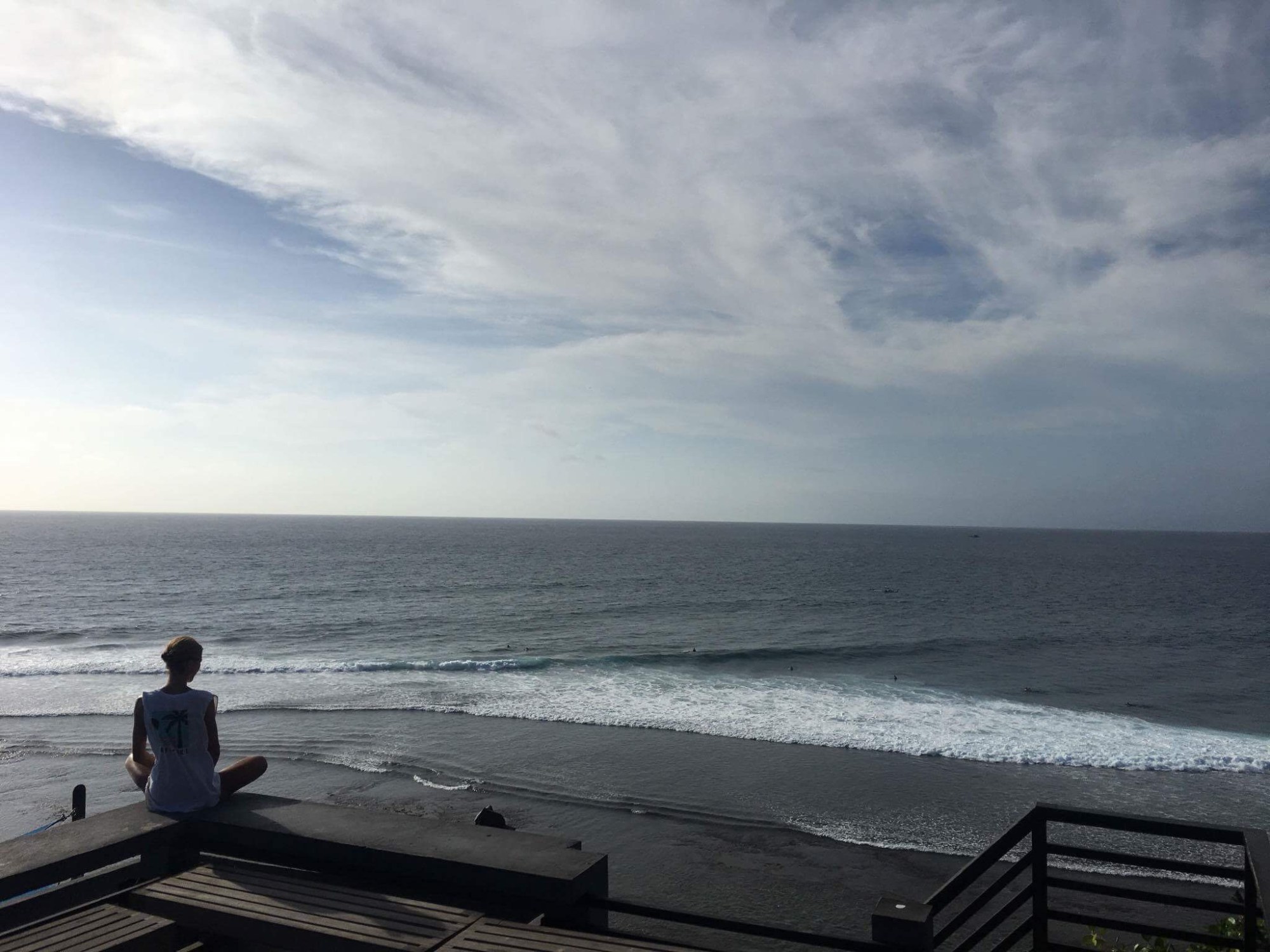
My first trip did not include any ceremonies, but this year, I was determined to change that: I had the privilege to witness not one but two apparently completelys fake ceremonies. Lucky ducky. Ceremony number one was a complete coincidence. I was back in the Bukit and had been told about a gorgeous beach facing South with little to no tourists (lies!). While quieter than other beaches, Pantai Pandawa is by no means a secret hangout and the massive hotel complexes that are currently under construction promise a grim future for this long white strip of beach. However, on this particular day, the beach was cram packed with people. Not tourists, but Hindus in traditional white sarongs, the men carrying colorful umbrellas and the women balancing baskets loaded to the brim with fruits and offerings on their heads. For purification purposes, sacred objects taken from the temple were carried to the ocean. Traditional music, incense, and the ocean: I was hooked. The sanctity of the ocean, as described by Eiseman above, is deeply rooted in the Balinese culture. Eiseman further writes: “[T]he gods did not get all of this mystic water from the sea, all the seawater still contains it, giving the sea the power to purify and sanctify.” Let’s hope the seven seas can clean up the mess before pollution completely annihilates their holiness.
The second ceremony – Galungan, the victory of Dharma (good) over Adharma (evil) – followed only a few weeks later. Leading up to the festivities, the streets were lined with bamboo poles, coconut leaves, and colorful decorations. Now back in Canggu, I made my way to the water temple Tanah Lot, which up until then I had always avoided. Why? The road leading down to the temples is flanked by tacky tourist shops and overpriced, Westernized warungs. Not this time. It seems a few ceremonies are the exception to Couteau’s rule. All the shops, apart from those run by Muslims, were closed. Thus, the journey down to the water was swift and undisturbed. Pura Tanah Lot sits on a large cliff on the West coast of Bali and literally translates to ‘land in the sea’. Even on low tide, the waves were violently crashing into the rock formation. The shrine itself is said to date back to the 16th century and has since mainly been used to worship the deity of the sea. I thanked the ocean god, received my share of holy water (Air Suci), some rice on my forehead, and a flower in my hair and left the temple site. The tide was coming in. The waves looked great, so I bowed my head in gratitude once more.
Close Out
“But were you aware that you and I worship water? … Look around, Kadek. There is water everywhere!”
(Jean Couteau, Myth, Magic and Mystery in Bali, p. 17, 2017)
The tourist distribution in Bali is very much centered around major sights, many of which are temples, volcanoes, surf and dive spots. However, this seemingly random spread of hot spots around Bali has little to do with a standard distribution. Rather, Couteau explains, Nusa Dua was strategically chosen as the epicenter of tourism in Bali, a decision that can be traced back Ida Bagus Mantra policies, who was governor of Bali from 1978 to 1988. “Their idea was to keep Bali as Balinese as possible. …They decided that tourists would … go to Ubud or other places by buses without interfering with the local society.” Matter-of-factly, he adds, “the local Balinese lost control over the evolution of their economy, including the tourism side. Now, 75 to 80 percent of the tourist industry is in the hands of non-Balinese capital from Jakarta or other places. That is playing with fire and results in an identity crisis within Bali.”
With current plans under way to construct a new airport for international flights in Bali’s Nothern Buleleng region, the island may soon be fully urbanized. Construction is set to start in 2020 and is estimated to take around five years. However, infrastructure and resources still have to be agreed upon. While villages and places with close to no tourists are still around in Bali, this may change with a rerouting of international flights. ”Half of the population is already urbanized and this will only increase. We are not in a rural society anymore, but have progressed to a service society. Tourism is already the main industry of Bali. It is not the kind of tourism the Balinese dreamed about.” Will billboard manufacturing of cultural symbols as cultural appropriation in disguise take the last bit of the old Bali that is still left and in turn increase the obsession with identity?
The latter has led the people back to written texts that intensify exclusion over inclusion. “Until ten years ago, I would still go into the villages to engage with the people. The pleasure is just not there anymore, simply due to traffic, unless I go further away. It does not have the richness it used to have but rather replicates the written texts.”
They say the pen is mightier than the sword, so maybe it is time to return to oral histories, stories that live off of personal anecdotes and interpretations respectively. Back to the tales that meander in ambiguity, personal accounts, the subjective, those that leave room for a plurality of abstract interpretations. Stories that are vague yet have a message, however blurred the lines might be. The concrete as well as clinging to written words and ideologies, a focus on tolerance rather than on a common ground may just be the things to get rid off to achieve a (un-)depth of field. Couteau writes: “…there is still, in the villages of Bali, another surviving logic, one that still gives the priority to gods and ancestors. May it never surrender to you, frenzied consumers of ordinary food, and extraordinary culture.” With a new airport underway, there is only hope that the Balinese people get a share of the big-fat tourism cake, too.
The Indonesian motto of “Unity in Diversity” may be more crucial than ever. Instead of practicing tolerance that points to differences, however, the element connecting locals, yogis, surfers, and other passers-by, may have been there all along: All hail water.
 Julia Kausch